
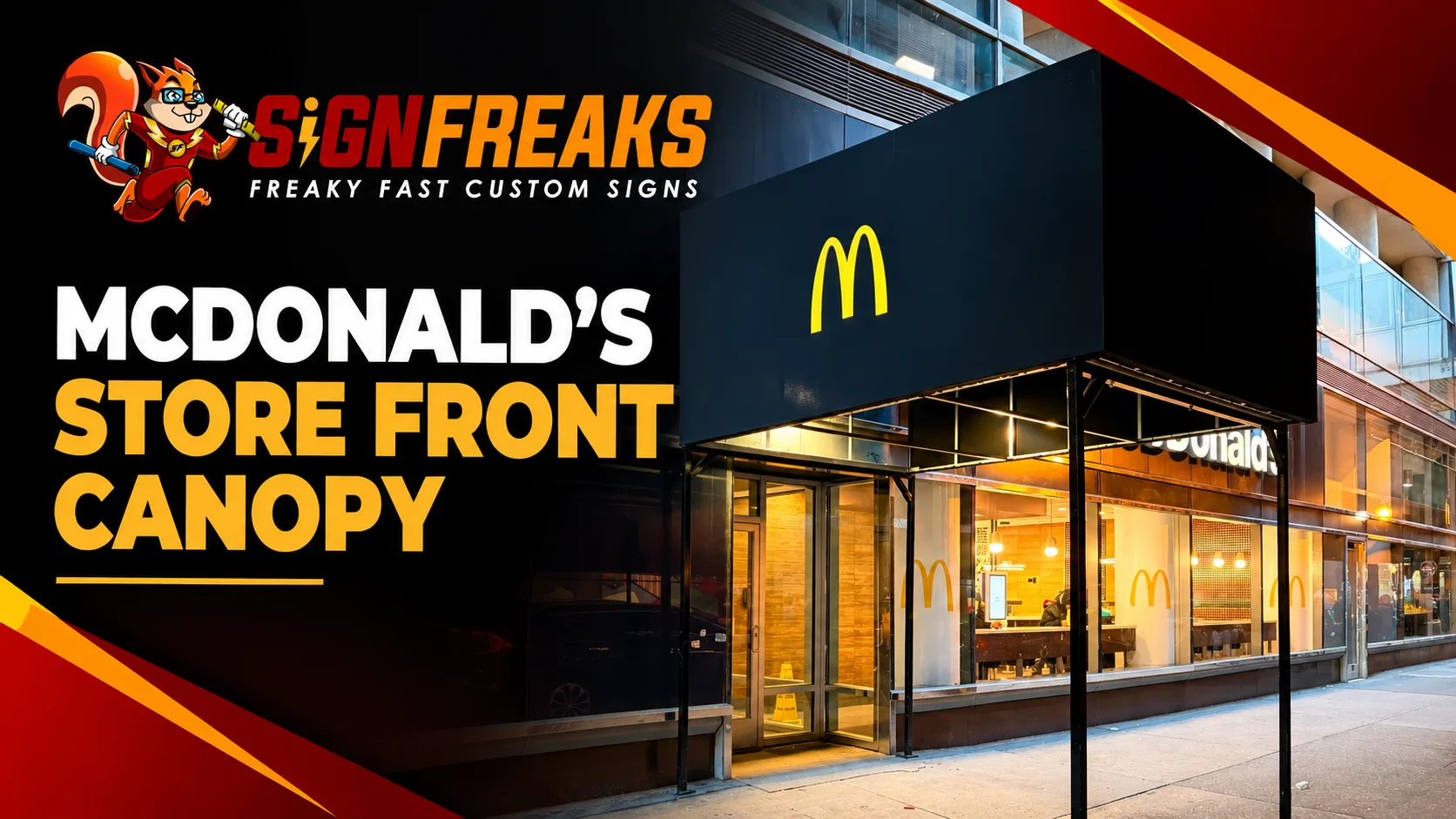
SignFreaks engineered, permitted, fabricated, and installed a branded storefront canopy for the McDonald’s at 203 N. LaSalle Street in the Chicago Loop. It uses a powder-coated aluminum frame with reinforced internal ribs, a color-matched Patio 500 vinyl and Sunbrella cover, and heavy-duty anchors set into structural masonry, and it went up without interrupting restaurant service.
A storefront canopy on a downtown Chicago restaurant has to do three jobs at once. It has to carry the brand, keep customers dry at the door, and stand up to snow loads, wind, and freeze-thaw cycles for years. For a global brand like McDonald’s, it also has to match corporate color standards exactly.
This case study covers how our team planned, engineered, permitted, built, and installed the entrance canopy at McDonald’s on LaSalle Street, and what other restaurant owners and franchise operators can take from it.
- Client
- McDonald’s
- Location
- 203 N. LaSalle St., Chicago, IL 60601
- Scope
- Site evaluation, engineering, permits, fabrication, and installation
- Frame
- Powder-coated aluminum with reinforced internal ribs
- Cover
- Patio 500 vinyl and Sunbrella canvas, color-matched to brand standards
- Install
- Lift work, anchors into structural masonry, no service interruption
Why This Storefront Canopy Was More Than Shade
LaSalle Street runs through the heart of the Loop, lined with towers, office workers, and constant foot traffic. A restaurant entrance there competes for attention with every other storefront on the block. The canopy had to be visible from the sidewalk and from passing cars, and it had to look unmistakably like McDonald’s.
Chicago’s climate adds a second set of demands. Snow loads, wind pressure, freeze-thaw cycles, and the city’s permitting process all shape how a storefront canopy is designed long before fabrication starts. The project goals came down to four points:
- Visibility. A branded entrance canopy that catches pedestrians and drivers.
- Weather protection. Real shelter at the door for customers in rain and snow.
- Brand accuracy. Colors and graphics that meet McDonald’s corporate standards.
- Compliance. Full approval under Chicago’s building and public way rules.
Planning and Permits Before Fabrication
The project started with a site evaluation. Our team checked the structural anchoring points on the facade, reviewed wind and snow load factors, and measured projection depth and pedestrian clearance against local rules.
A restaurant canopy over a Chicago sidewalk is a structure over the public way, so the paperwork is heavier than for a sign flat on a wall. According to the City of Chicago, a business first needs a Department of Buildings permit, then a Grant of Privilege application through the Department of Business Affairs and Consumer Protection, which prepares an ordinance for City Council approval.
For this canopy, the permit package covered:
- Zoning restrictions and public way clearance.
- Structural calculations and stamped engineering drawings.
- Canopy attachment details for the facade.
- The city’s submission requirements, prepared before filing.
Settling these questions before fabrication kept inspection risk low and the approval path predictable. We handle sign permits this way on every project, because the permit is the step nobody can rush.
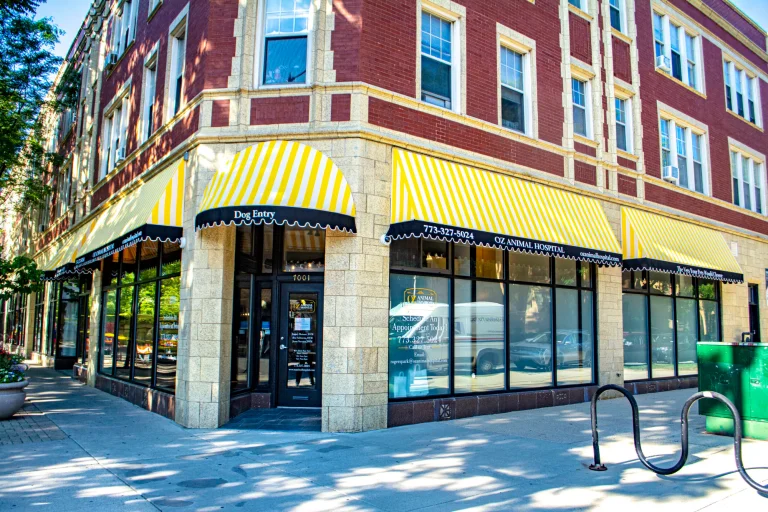
Canopy or awning? The terms overlap, but a canopy usually has a heavier frame and more projection, sometimes with posts, while an awning is a lighter cover fixed to the wall. Both need the same public way approvals when they extend over a Chicago sidewalk. Our awning signs guide covers the branding side of both.
Materials Chosen for a Chicago Storefront Canopy
Every material on this storefront canopy was picked for long-term performance in a dense, harsh urban setting, while keeping the brand precise.
| Component | Material | Why it was chosen |
|---|---|---|
| Structural frame | Powder-coated aluminum | Resists corrosion from moisture and road salt while staying rigid |
| Internal supports | Reinforced rib system | Spreads snow and wind loads across the frame |
| Cover | Patio 500 vinyl and Sunbrella canvas | UV-resistant, waterproof, and selected to meet fire-safety requirements |
| Graphics | Digitally color-matched cover | Meets McDonald’s brand color standards |
| Anchoring | Heavy-duty anchors and fasteners | Set into structural masonry to protect the facade |
The reinforced ribs do the quiet work. They keep the cover tight and stop snow from settling into pockets, the same principle covered in our guide to snow awnings.
Fabrication and Installation
- CAD modeling The frame was modeled before production to confirm projection, alignment, and how loads spread through the structure.
- In-house fabrication Frames and covers were built in our own shop, so one team controlled quality from design through final assembly.
- Dry assembly The full canopy was assembled in the shop before transport to check fit and fabric tension, which cut down adjustments on site.
- Installation Our crew installed the canopy from a lift under strict safety procedures, anchored it into structural masonry, and tensioned the cover for a smooth, wrinkle-free finish.
The work ran on a tightly managed schedule with no interruption to daily restaurant operations. For a busy downtown location, that’s as important as the canopy itself. Our sign installation crew plans every downtown job around the business’s hours and the street’s traffic.
Planning a restaurant canopy?
Our team handles the engineering, the city approvals, the fabrication, and the install for restaurant and franchise storefronts across Chicago and the suburbs.
Storefront Canopy Mistakes This Project Avoided
Many storefront canopies in Chicago fail early, and the causes repeat. Planning this project around them is what kept the LaSalle Street canopy tight, compliant, and on schedule.
- Anchoring into the wrong material. Fasteners set into mortar joints or facade cladding loosen under wind and snow. Here, the anchors went into structural masonry.
- A frame sized only for shade. A frame built without snow and wind loads in mind sags by its second winter. The reinforced ribs prevent that.
- Color that drifts from the brand. Stock fabric colors rarely match a corporate palette. Digital color matching closed the gap.
- Permits started too late. A canopy over the public way can’t go up until the city signs off, so the paperwork started at the site evaluation, not after fabrication.
- Fit problems discovered on the street. Dry-assembling the canopy in the shop caught fit issues before the crew reached the sidewalk.
A restaurant canopy is only one piece of a winter-ready entrance. For doors that let cold air pour into the dining room, commercial vestibules stop the draft, and a patio canopy covers outdoor seating. Many restaurants also add channel letters above the canopy so the name reads after dark.
How the Storefront Canopy Performs
The finished canopy gives the entrance structure and weight. The reinforced ribs keep the fabric under tension, the UV-resistant cover holds its color, and the waterproof material keeps moisture and mildew out.
Beyond protection, the canopy frames the entrance. It guides customers to the door, adds presence at street level, and keeps the brand visible to drivers on LaSalle Street. In a high-traffic urban setting, those details shape how customers see the restaurant before they ever walk in.
What Restaurant and Franchise Owners Can Take From This Project
Big brands need consistency, regulatory fluency, and the ability to repeat the same result at every location. The same lessons apply to an independent restaurant or a single franchise unit:
- Start with the permit path. A canopy over the sidewalk takes several approvals, so build them into the schedule from day one.
- Engineer for the climate. Snow and wind loads should set the frame design, not the other way around.
- Match the brand exactly. Digital color matching keeps one location consistent with the rest of the chain.
- Protect the opening day. A crew that works around your hours keeps the restaurant open during the install.
We build restaurant signs and canopies for independents and franchises alike, and our work for shopping centers follows the same approval-first process.
Planning a Storefront Canopy for Your Restaurant
The McDonald’s project on LaSalle Street shows what a storefront canopy can deliver when engineering, compliance, and branding are planned together. The result is an entrance that shelters customers, carries the brand, and holds up to Chicago weather.
SignFreaks designs, permits, builds, and installs commercial canopies, entrance canopies, and awnings across Chicago and the suburbs. More finished projects are in the portfolio.
Get a storefront canopy built for your brand
Tell SignFreaks your address and opening date. We’ll evaluate the site, handle the permits, and build a canopy that matches your brand and holds up to Chicago winters.
Storefront Canopy FAQs
What is a storefront canopy?
A storefront canopy is a framed cover that projects from a building over its entrance, sheltering customers and carrying the business name or brand colors. SignFreaks builds commercial canopies with aluminum or steel frames and fabric or vinyl covers.
Do you need a permit for a restaurant canopy in Chicago?
A restaurant canopy in Chicago needs a permit, and one that extends over the sidewalk also needs a Grant of Privilege from the city and City Council approval. SignFreaks prepares the drawings and files the sign permits for every canopy we install.
What materials last longest on a storefront canopy?
The materials that last longest on a storefront canopy are a powder-coated aluminum or galvanized steel frame and a UV-resistant, waterproof cover such as Patio 500 vinyl or Sunbrella canvas. Reinforced internal ribs keep the cover tight under snow.
Can a canopy be installed without closing the restaurant?
A canopy can be installed without closing the restaurant when the work is planned around operating hours. On the McDonald’s project, our installation crew worked from a lift and kept the entrance open.