
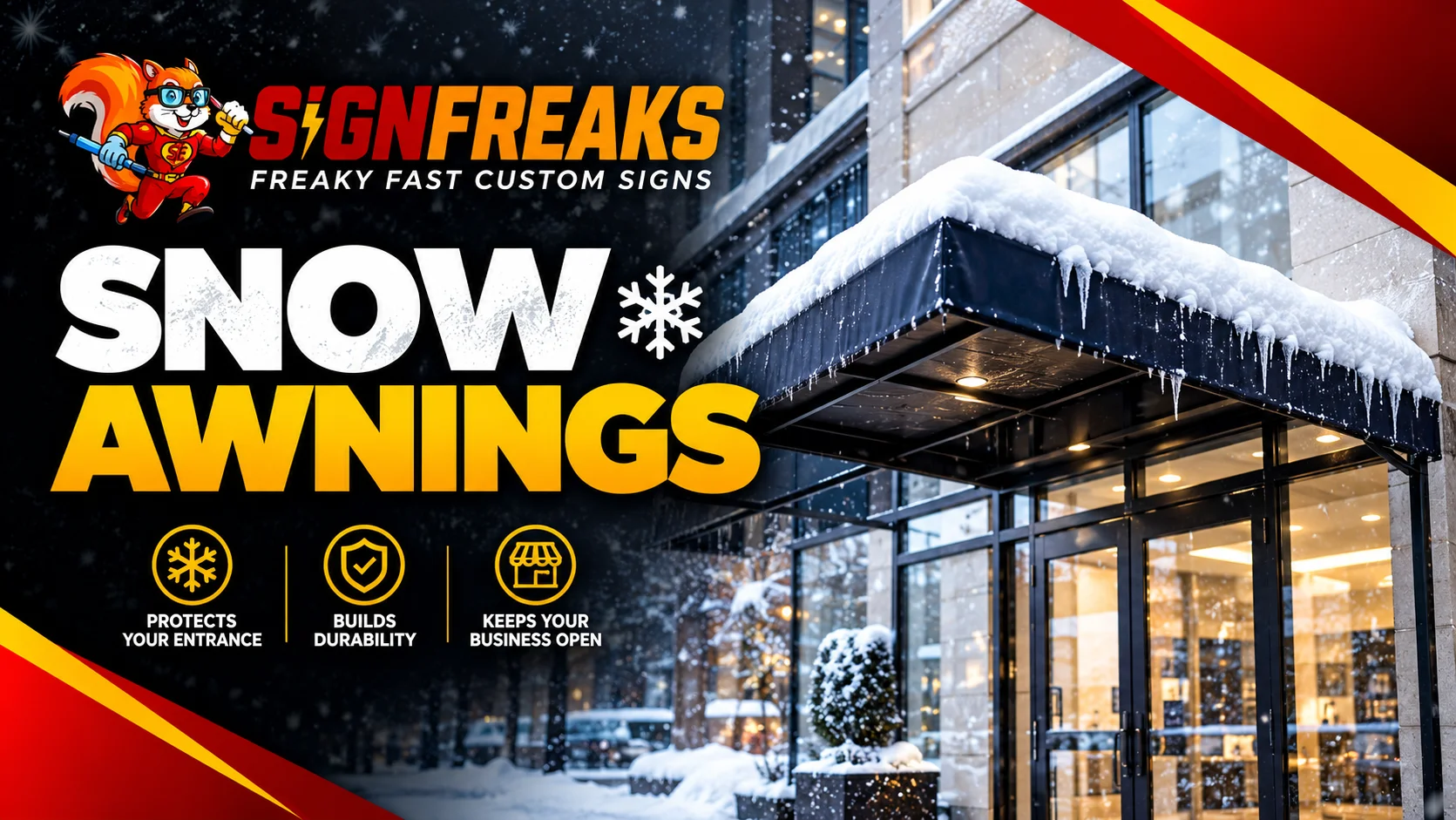
Snow awnings are fixed commercial awnings built to carry winter weight: a steel or heavy aluminum frame, a steep pitch that sheds snow, internal crossbars, and anchors rated for the load. In Chicago, the building code’s ground snow load is 25 pounds per square foot, so the frame has to be engineered for real weight, not just shade.
A Chicago storm can leave a foot of snow on a storefront awning overnight. Then the temperature climbs a few degrees, the top layer turns wet, and the weight on your storefront awning frame climbs with it. Snow awnings are built for that night. A standard shade awning isn’t, and it shows by February: sagging fabric, bent arms, and brackets pulling out of the masonry.
This guide covers what snow does to an awning, the structural features that keep one standing, the materials that survive freeze-thaw cycles, and the winter care that extends its life. It’s written for business owners and property managers across Chicagoland choosing a new awning or replacing one that didn’t make it through last winter.
- Weight builds fast. About a foot of fresh snow, a few inches of packed snow, or one inch of ice each adds roughly 5 pounds per square foot.
- Pitch beats strength alone. A steep slope sheds snow before it piles up, while flat and low-angle awnings hold it.
- Anchors fail first. Brackets and fasteners set into weak masonry usually give out before the frame does.
- Retractable awnings don’t belong in snow. They have to come in before a storm, which is why fixed awnings win in Chicago.
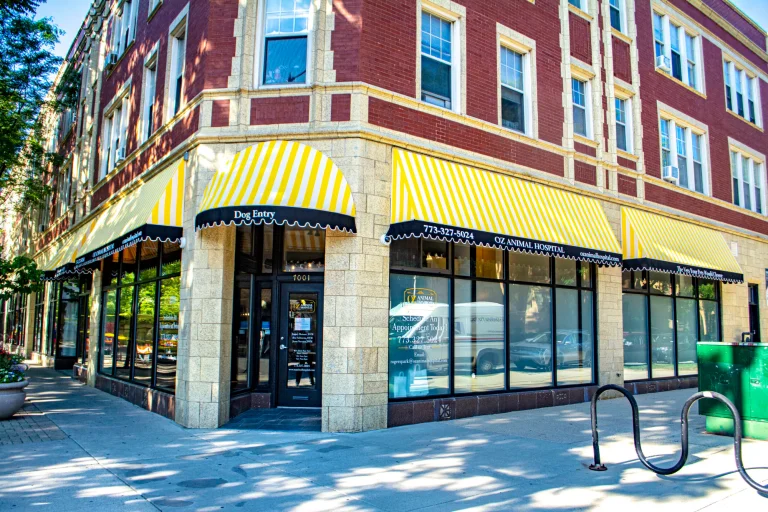
What Snow Actually Weighs on an Awning
Snow load is the weight accumulated snow puts on a structure, measured in pounds per square foot (psf). Most awning failures come from underestimating it. Fresh powder looks light, but it settles, absorbs rain, and refreezes into something much heavier.
The Insurance Institute for Business and Home Safety offers a simple rule of thumb, published by Maine Emergency Management: each of these equals about one inch of water and roughly 5 psf.
- 10–12inof fresh snow adds about 5 psf
- 3–5inof packed, older snow adds about 5 psf
- 1inof ice adds about 5 psf
Figures from IBHS guidance. Chicago’s design ground snow load is 25 psf.
Do that math on a 20-foot storefront awning with a 4-foot projection. That’s 80 square feet of surface. Two feet of settled snow with an ice crust can put well over a thousand pounds on the frame and its wall anchors.
Chicago’s code doesn’t leave this to guesswork. Section 1608.2 of the city’s structural provisions sets the ground snow load at 25 psf, and design loads follow ASCE 7, including drift. An awning that sits below a taller roof or parapet also catches snow that slides or blows off the building above, so its real load can run well past what falls on it directly.
Why Standard Awnings Fail Under Snow
Most awnings that fail in winter were never designed as a snow awning in the first place. They were specified for shade and branding, then left up through January. The damage follows a predictable pattern:
- Sagging frames. Thin tubing or wide rafter spacing lets the frame bow, which creates a pocket that collects even more snow.
- Bracket failure. Anchors set into soft brick, mortar joints, or EIFS loosen under repeated load and wind.
- Stretched or torn fabric. Covers lose tension, start ponding meltwater, and tear along seams.
- Ice in the seams. Water gets into stitching, freezes, expands, and opens the seam a little more each cycle.
- Icicle damage. Heavy icicles along the valance pull at the fabric edge and drop on customers below.
On a busy sidewalk, a failing awning is more than a repair bill. It’s a liability over your front door.
Watch the awning under a taller roof. Snow that slides off an upper roof or drifts against a parapet lands on the awning below it. If your storefront sits under a setback or a taller neighbor, tell your sign company before the frame is sized.
Need to stop the cold, not just the snow? An awning keeps snow off the doorway, but it won’t stop wind from pouring in every time the door opens. For that, pair it with one of our commercial vestibules.
Five Features of Snow Awnings Built for Chicago
The best awnings for snow share the same five traits. Snow awnings that last come down to engineering choices, most of which you can’t see once the fabric is on. Ask about each of these before you sign off on a design.
1. A Reinforced Frame
Welded steel or heavy-wall aluminum tubing resists bending under repeated load. Rafter spacing counts as much as the material, since closer rafters give the fabric fewer places to sag.
2. A Steep Pitch
Slope is your first line of defense. A steeper awning sheds snow before it accumulates, while flat and shallow designs hold every inch that lands. Traditional sloped and dome shapes shed better than a nearly flat contemporary profile.
3. Internal Crossbars
Crossbars tie the rafters together and spread the load across the whole frame. Without them, weight concentrates at the center, which is exactly where most frames start to bow.
4. Anchors Matched to the Wall
The wall is part of the structure. Brick, block, concrete, and steel each need different fasteners, and old masonry may need through-bolts or a backing plate. Load ratings on the anchors should match the frame’s design load.
5. Tight, Even Fabric Tension
A cover stretched tight across the frame lets snow slide and water drain. A loose cover dimples, ponds, and adds the weight of standing water and ice to everything else.
| Style | Snow performance | Why |
|---|---|---|
| Steep-pitch fixed fabric awning | Strong | Sheds snow early; a rigid frame keeps tension |
| Rigid metal canopy | Strong | Metal panels and heavy framing carry more weight than fabric |
| Post-supported entrance canopy | Strong | Posts carry part of the load to the ground instead of the wall |
| Low-pitch or flat awning | Weak | Snow piles up and melts into standing water and ice |
| Retractable awning | Not rated | Has to be rolled in before snow; the arms aren’t built to carry it |
Is your awning ready for this winter?
SignFreaks surveys the wall, checks the frame and anchors, and builds fixed awnings for Chicago snow in our own shop. Send a photo of your storefront to start.
Materials for Snow Awnings That Hold Up to Freeze-Thaw
Chicago winters bring cycles of freezing and thawing, sometimes several in one week. Each cycle works water deeper into weak points, so material choice decides how long snow awnings last.
- Powder-coated aluminum. Light, strong, and protected against the moisture and road salt that corrode bare metal. It’s the standard frame for most storefront awnings.
- Galvanized steel. Carries more weight than aluminum and suits large entrance canopies, walkway canopies, and long spans that need extra load capacity.
- Vinyl-laminated fabric. Covers such as Patio 500, the same fabric used on our DMV vestibule enclosures, shed water and stay flexible in the cold, which keeps them from cracking when temperatures drop.
- Acrylic canvas. Woven fabrics such as Sunbrella hold color well and breathe, though they need good tension and pitch to shed snow.
- Sealed, reinforced seams. Weather-resistant thread and welded or taped seams keep water from freezing inside the stitching.
Winter Maintenance for a Snow Awning
Even a well-built snow awning lasts longer with a little attention. Most of the work happens before the first storm, and SignFreaks can handle the inspection steps for you.
- Inspect before November Check brackets, fasteners, and welds, and look for loose anchors or rust at the wall line. Fix them while the weather still allows it.
- Clear heavy buildup after big storms Push snow off from below with a soft broom or roof rake. Never chip ice with a shovel or sharp tool, which can cut the fabric.
- Keep drainage open Make sure meltwater runs off the low edge and isn’t trapped by debris or a sagging section.
- Knock down icicles safely Clear them from the valance when no one is walking below, since falling ice is a hazard at a busy entrance.
- Book a spring check Have a professional look at tension, seams, and anchors after the season. Our sign repair crew can re-tension fabric, reseal seams, and reset loose anchors before they fail.
Engineering and Permits for Awnings in Chicago
An awning over a Chicago sidewalk is a structure over the public way. It typically needs a building permit plus Public Way Use approval from the city, and suburbs set their own rules for size, projection, and clearance. Drawings for larger frames may need engineering that accounts for snow and wind loads.
SignFreaks handles sign permits as part of every awning project, so the frame is designed, approved, and installed as one job. The SignFreaks crew measures the wall, checks what it can carry, and sizes the frame before any fabric is cut, then handles installation with our own lift.
Choosing Snow Awnings Before the Next Storm
The best time to replace a weak awning is before it fails over your entrance. The best awnings for snow have a steep pitch, a reinforced frame with crossbars, anchors matched to your wall, and fabric that stays tight in the cold. Skip retractable models if the awning has to stay up through winter.
SignFreaks designs, fabricates, permits, and installs snow awnings, fixed commercial awnings and commercial canopies for Chicago and the suburbs.
Restaurants can also look at patio awnings and restaurant signs for the rest of the frontage. If you’re comparing styles first, the guide to the types of awnings covers the options. When you’re ready, we’ll spec a snow awning that holds up through February.
Get a snow awning built for Chicago winters
Tell us about your entrance, and we’ll check the wall, size the frame, handle the permit, and install an awning that’s still standing in March.
Snow Awnings FAQs
How much snow can an awning hold?
How much snow an awning can hold depends on its frame, pitch, span, and anchors, so the answer comes from its design load rather than a single number. Chicago’s code uses a 25 psf ground snow load as the starting point, and a properly engineered commercial awning is sized for that plus any drift from the roof above.
Should you remove snow from an awning?
You should remove heavy snow from an awning after major storms, especially wet snow or snow with an ice crust. Push it off from below with a soft broom or roof rake, and never use a shovel or sharp tool on the fabric.
Are metal awnings better for snow than fabric?
Metal awnings are generally better for heavy snow than fabric ones, because rigid panels and heavier framing carry more weight. A steep fabric awning on a reinforced frame still performs well, and post-supported entrance canopies add extra capacity at busy doorways.
Do awnings need a permit in Chicago?
Awnings in Chicago need a permit in most cases, and an awning over the sidewalk also needs Public Way Use approval. Suburbs set their own size and clearance rules. SignFreaks prepares and files the sign permits for every awning we build.