
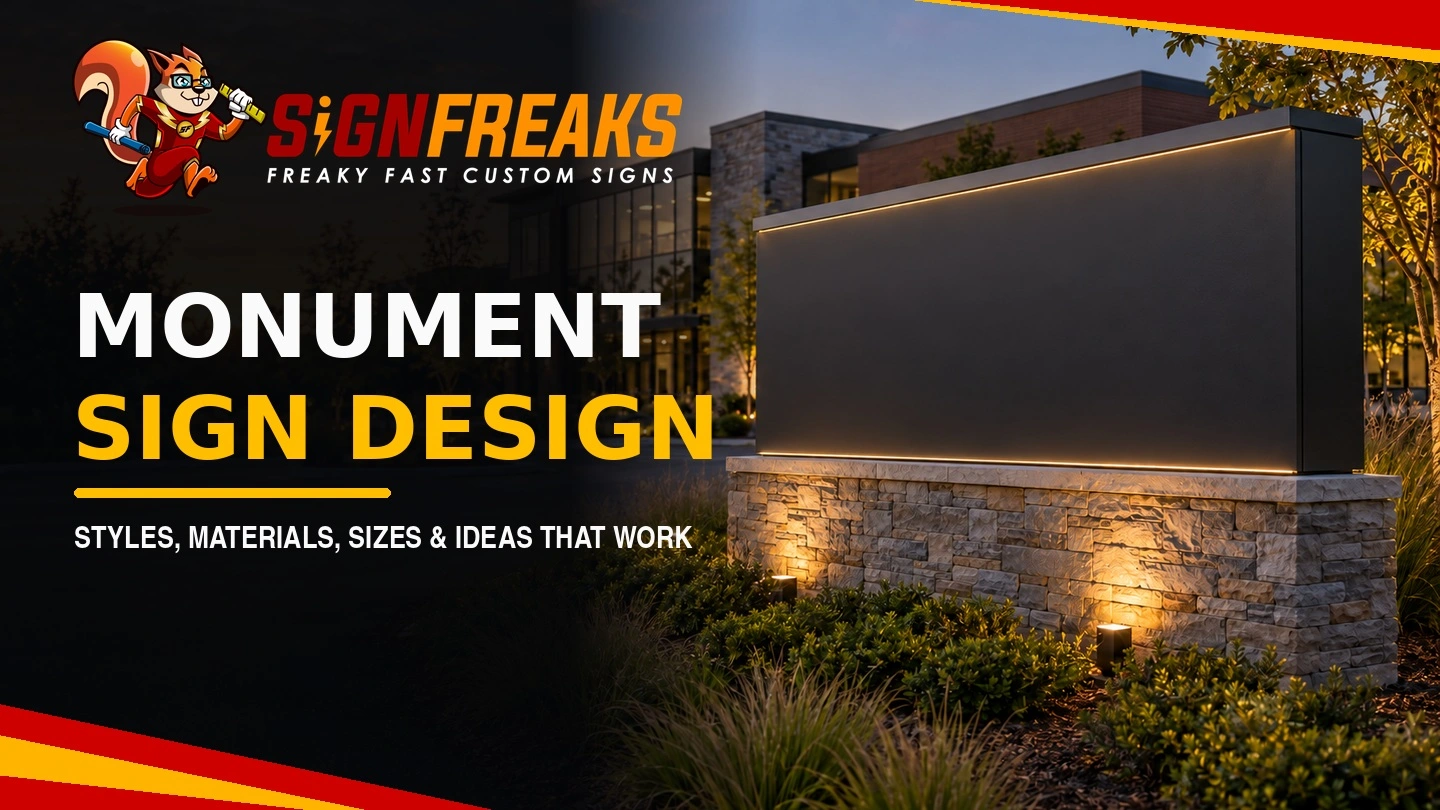
Good monument sign design starts with the site: how far back the building sits, how fast traffic moves, and what the local code allows. From there, pick a material that matches the building, keep the copy to a name, logo, and address, use strong contrast, and decide how the sign will be lit. A monument sign built this way reads from the road and looks like part of the property.
A monument sign is often the first thing a visitor sees, sometimes before the building itself. When the monument sign design is wrong, the result is a heavy block by the driveway that nobody can read at 35 miles per hour, or one that looks cheap next to a well-kept building.
This guide walks through monument sign design from the ground up: what a monument sign is, the materials and styles to choose from, design ideas that hold up, size and height rules, lighting, and installation. It’s written for property managers, business owners, and facility teams planning a new sign or replacing an old one.
- Design for the approach. Size and placement follow how fast and from where visitors arrive.
- Less copy reads better. A name, a logo, and an address beat a crowded face.
- Match the building. Masonry, stone, and finished aluminum should echo the architecture.
- Check height limits early. Chicago ties freestanding sign height to lot frontage and street width.
What Is a Monument Sign?
A monument sign is a low, freestanding sign set on a solid base at ground level, usually near a driveway or main entrance. Unlike a pylon sign on poles, it sits close to the ground and reads as part of the grounds. That’s why office parks, medical centers, schools, churches, and hotels rely on them.
So what is a monument sign built from? Most combine a concrete foundation, a steel or aluminum internal frame, and an exterior of masonry, stone veneer, fabricated aluminum, or high-density urethane (HDU). The face carries routed panels, dimensional letters, or a lit cabinet.
If you’re weighing a taller sign, our guide on what a pylon sign is compares the two side by side.
Monument Sign Design Starts With the Site
Before choosing colors or fonts, look at the site the way a first-time visitor does. Four questions shape everything that follows:
- How fast is traffic moving? A sign on a 45 mph road needs larger letters and a simpler message than one on a campus drive.
- Where do visitors approach from? A double-sided sign set perpendicular to the road reads from both directions.
- What blocks the view? Parked cars, snowbanks, and landscaping can hide a low sign. Raising it on a base or berm keeps it visible.
- What is the setback? Codes often require signs to sit a set distance from property lines and driveways for sightlines.
The United States Sign Council’s legibility guidelines give a useful starting point: about 30 feet of viewing distance per inch of capital letter height on average, with larger letters needed on busy roads. A name that drivers must read from 300 feet needs letters close to 10 inches tall.
Types of Monument Signs and Materials
The type of monument sign you choose sets its look, its lifespan, and how easy it is to update. These are the most common options:
| Type | Look | Best for |
|---|---|---|
| Brick or masonry | Solid, traditional, permanent | Schools, churches, office parks |
| Stone veneer | Natural and upscale | Hotels, medical campuses, corporate sites |
| Fabricated aluminum | Clean and modern, any color | Retail centers and contemporary buildings |
| HDU (carved foam) | Sculpted or carved detail | Hospitality and decorative entrances |
| Illuminated cabinet | Lit face, readable at night | Businesses open after dark |
| Digital message center | Changeable LED messages | Schools, churches, and event venues |
| Multi-tenant | Panels for several businesses | Plazas and office buildings |
Masonry reads as permanent but is harder to change later. Fabricated aluminum, finished to match the building, is lighter and makes future rebrands easier. For multi-tenant sites, design removable panels into the frame from the start, since adding a panel system later is much harder.
Monument Sign Design Ideas That Work
The strongest monument signs follow a few simple principles. These monument sign design ideas apply to a single sign or a full set across a campus.
- Keep the copy short. Name, logo, and street number. Hours, phone numbers, and service lists turn into clutter at driving speed.
- Use high contrast. Light letters on a dark face, or dark on light, read farthest. Avoid colors that blend into the base material.
- Go dimensional. Raised or halo lit letters add depth and shadow, which helps the name read in low sun and at night.
- Echo the architecture. Use the building’s brick, stone, metal, or color palette so the sign looks like it belongs.
- Put the address on it. Clear street numbers help visitors, delivery drivers, and emergency crews find the entrance.
- Frame it with landscaping. Low plantings around the base finish the look, as long as they never grow taller than the copy.
Modern monument signs often pair a slim aluminum cabinet with a stone or masonry base, combining clean lettering with a solid footing. Contemporary designs also use cut-through letters, accent lighting, and mixed materials.
Planning a monument sign?
SignFreaks surveys the site, checks the local height and setback rules, and shows you the sign to scale on a photo of your property before anything is built.
Size and Height Rules for Monument Signs
Every city and village writes its own rules for freestanding signs, so size starts with the code. In Chicago, a freestanding sign can reach 24 feet on a lot with 75 feet of street frontage or less, and Pedestrian Streets don’t allow freestanding signs at all. Most monument signs sit far below those limits.
Chicago’s sign permit rules add two thresholds. Ground signs with a top more than 24 feet above grade need engineered drawings, and any sign over 100 square feet or 24 feet high needs a City Council Order. Suburbs vary. Oak Brook, for example, asks for a landscaping plan with monument sign applications, a rule covered on the Oak Brook page.
Lighting a Monument Sign
A monument sign that goes dark at sunset stops working for half the day in winter. There are three common ways to light one:
- Internal LEDs. A lit cabinet face, built much like a lightbox sign, gives the crispest nighttime read.
- Ground-mounted fixtures. Up-lights wash a masonry or stone face for a softer, architectural look.
- Halo lighting. LEDs behind dimensional letters cast a glow onto the base, a refined option for corporate and hospitality sites.
Installing a Monument Sign
- Site evaluation The crew checks soil, sightlines, utilities, and setbacks before the location is final.
- Foundation A concrete footing sized to the sign’s weight and wind load anchors the structure.
- Electrical Power is trenched to the sign for lit faces or ground fixtures, and a registered electrical contractor connects it.
- Setting and finishing The sign is set, leveled, sealed, and checked for alignment before landscaping goes in around the base.
SignFreaks prepares the drawings, files the sign permits, builds the sign in our own shop, and handles installation with our own crew. When an older sign needs new LEDs or panels, sign repair can update it without a full rebuild.
Planning Your Monument Sign Design
Strong monument sign design comes from reading the site first, keeping the message short, choosing materials that match the building, and lighting the sign for the hours visitors arrive. Check the height and setback rules before the first drawing, and build tenant panels in from the start if the sign will ever list more than one business.
SignFreaks designs, permits, builds, and installs monument signs for corporate buildings, hospitals, schools, and shopping centers across Chicago and the suburbs. For other sign options, see the guide to types of business signs.
Get a monument sign designed for your site
Tell SignFreaks about your property. We’ll survey the site, design the sign to your building and the local code, handle the permit, and install it with our own crew.
Monument Sign Design FAQs
What is a monument sign?
A monument sign is a low, freestanding sign on a solid base at ground level, usually near a driveway or entrance. It’s typically built from masonry, stone, aluminum, or HDU on a concrete foundation. SignFreaks builds monument signs for businesses and institutions across Chicago.
How big should a monument sign be?
A monument sign should be big enough for drivers to read the name at the speed and distance they approach, within the local code’s limits. About one inch of letter height per 30 feet of viewing distance is a common starting point.
What is the best material for a monument sign?
The best material for a monument sign depends on the building. Masonry and stone suit traditional and upscale sites, while fabricated aluminum suits modern buildings and makes future updates easier. Many designs combine a masonry base with an aluminum cabinet.
Do monument signs need a permit in Chicago?
Monument signs in Chicago need a permit, and taller or larger signs can need engineered drawings and a City Council Order. SignFreaks prepares the drawings and files the sign permits for every monument sign we install.
Can a monument sign be lit?
A monument sign can be lit with internal LEDs behind the face, ground-mounted fixtures that wash the base, or halo lighting behind dimensional letters. An internally lit face works like a lightbox and gives the clearest read at night.