
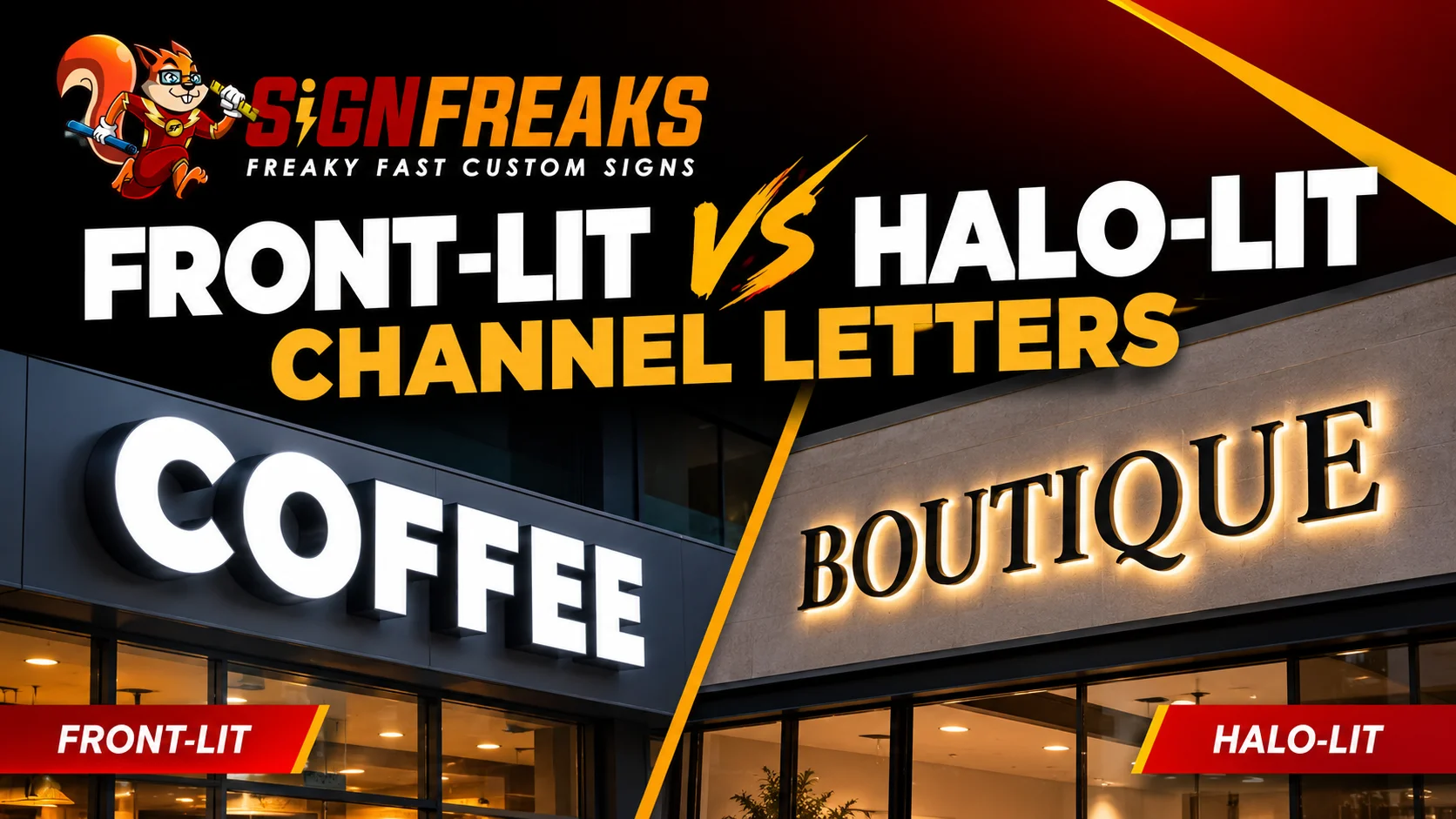
Front lit channel letters shine through a colored acrylic face, so they read brightest and farthest, which suits retail strips and busy roads. Halo lit channel letters have solid metal faces and LEDs pointed at the wall, creating a soft glow around each letter that suits offices, hotels, and upscale storefronts. Pick front lit for distance and halo lit for a refined look up close.
Two storefronts on the same block can spend similar money on channel letters and get completely different results after dark. One glows bright red from a block away. The other shows crisp metal letters framed in a soft white halo. The difference is the lighting style, and it’s the first decision your sign company will ask you to make.
This guide compares halo lit channel letters and front lit channel letters on visibility, look, building fit, upkeep, and what drives the price, so you can choose the style that fits your brand, your wall, and your street.
- Front lit reads farther. Light shines straight through the face, so the letter itself is the bright part.
- Halo lit looks more refined. The face stays dark metal, and the glow lands on the wall behind it.
- The wall decides the halo. Smooth, light surfaces reflect a clean halo, while dark or rough brick dulls it.
- You can combine them. Front and back lit letters put light on the face and a halo behind it.
How Front Lit Channel Letters Work
Front lit channel letters, also called face lit letters, are the most common illuminated sign on American storefronts. Each letter is a shallow aluminum can with sides called returns. LED modules sit inside, and a translucent acrylic or polycarbonate face snaps onto the front with a plastic edge called trim cap.
When the LEDs switch on, the whole face glows. Faces come in dozens of acrylic colors, and printed or perforated vinyl can be layered on top to match exact brand colors. A popular option is day-night film, which looks black during the day and glows white at night.
That direct light is what makes front lit channel letters so readable. The United States Sign Council found that internally lit signs gave drivers 40 to 60 percent longer reading distances than signs lit from outside. For a shop that depends on passing traffic, that extra distance is real money.
How Halo Lit Channel Letters Work
Halo lit channel letters flip the design around. They’re often called reverse channel letters or reverse lit letters, because the light faces backward. The face and returns are solid metal, usually painted or brushed aluminum, or stainless steel for a premium finish. The back is open or covered with clear polycarbonate.
Each letter mounts on standoffs that hold it an inch or two off the wall. The LEDs inside point at the wall, light spills out around the edges, and the wall lights up in the shape of each letter. Up close, it reads as a crisp silhouette with a glowing outline, which is why so many hotels, law firms, and corporate lobbies use halo lit channel letters.
The wall is part of a halo lit sign. A smooth, light-colored surface such as limestone, painted EIFS, or a metal backer panel reflects an even halo. Dark brick, glass, or a rough surface swallows the light. When the wall won’t cooperate, we mount the letters on a finished acrylic or aluminum backer.
Halo Lit vs Front Lit Channel Letters Compared
SignFreaks builds both styles with the same LED technology and the same basic fabrication, so neither is cheap or flimsy. Where they differ is in what the viewer sees and where each one works best.
| Factor | Front lit | Halo lit |
|---|---|---|
| Light direction | Through the face, toward the street | Out the back, onto the wall |
| Face material | Translucent acrylic or polycarbonate | Solid aluminum or stainless steel |
| Night visibility | Strongest at distance | Best at close and mid range |
| Daytime look | Colored faces with trim cap | Clean metal letters, no trim cap |
| Color matching | Wide range through acrylic and vinyl | Paint on the face; halo usually white or warm white |
| Wall requirements | Works on almost any surface | Needs a smooth, light surface or backer |
| Typical fit | Retail, restaurants, shopping centers | Offices, hotels, salons, upscale retail |
Which Style Fits Your Business?
Start with three questions: how far away your customers are when they need to see the sign, what your brand looks like, and what your wall and landlord allow.
Choose Front Lit Channel Letters If
- Most customers see you from a car, across a parking lot, or from the far side of a wide street.
- Your brand relies on specific colors that need to glow at night.
- You’re in a strip center or mall where the landlord’s sign criteria call for face lit letters, which many do. Our shopping mall signs work starts with those criteria.
- You compete with neighbors’ signs for attention after dark, as many restaurants do.
Choose Halo Lit Channel Letters If
- Customers see you on foot or at close range, as in a lobby, a pedestrian street, or a downtown storefront.
- Your brand is understated or premium, such as hotels, salons, and professional offices.
- The facade is smooth stone, painted masonry, or a panel that can carry the halo.
- You want the sign to look like part of the architecture during the day.
Consider Front and Back Lit Letters If
Combination lit letters put a translucent face on the front and leave the back open, so you get a bright face and a halo behind it. They cost more than either single style, but they carry well at distance while still adding depth up close. They’re a strong pick for flagship locations and corporate buildings that need both reach and polish.
Not sure which lighting your wall can carry?
SignFreaks will look at your facade, your landlord’s criteria, and your street, then show you both styles on a photo of your own building before anything is built.
What Drives the Cost of Each Style
Every channel letter sign is priced from its own measurements, so there’s no honest flat rate. What you can know in advance is which factors move the quote:
- Letter height and count. Bigger letters and longer names take more metal, more LEDs, and more labor.
- Face and return materials. Halo lit letters need finished metal faces, and stainless steel costs more than painted aluminum.
- Mounting. Standoffs for halo letters, a raceway, or a backer panel each add parts and install time.
- Lighting style. Halo lit and combination lit letters usually take more fabrication time than standard front lit letters.
- Access and permits. Lift work, electrical, and sign permits all appear as their own line items.
In general, front lit channel letters are the more budget-friendly option, and halo lit channel letters cost more for the same size because of the metal faces and finishing.
Permits and Installation in Chicago
Lighting style doesn’t change the permit question. Halo lit channel letters and front lit letters both need one in most places. In Chicago, the City’s sign permit rules require engineered drawings for the installation of new sign boxes or channel letters, and illuminated signs need a registered electrical contractor on the application. Suburbs set their own size and lighting limits.
SignFreaks prepares the drawings, files the permit, builds the letters in our own shop, and handles sign installation with our own crew and lift. One team answers for the whole job.
Maintenance and Lifespan
Both styles run on LED modules, which use far less power and last far longer than the neon that lit channel letters for decades. Upkeep differs a little:
- Front lit letters. Wipe the faces to keep them bright. Over many years, acrylic faces can fade, and they can be replaced without rebuilding the letter.
- Halo lit letters. Keep the wall behind the letters clean, since dirt and grime dull the halo before the LEDs do.
- Both. Modular LEDs and power supplies can be swapped one at a time. If a letter goes dark, sign repair is usually a quick part replacement.
Choosing Between Halo Lit and Front Lit Channel Letters
Choose front lit channel letters when distance and color carry the sale. Choose halo lit channel letters when your customers are close and the building’s look counts as much as the name. If you need both, combination lighting gives you reach and depth in one sign.
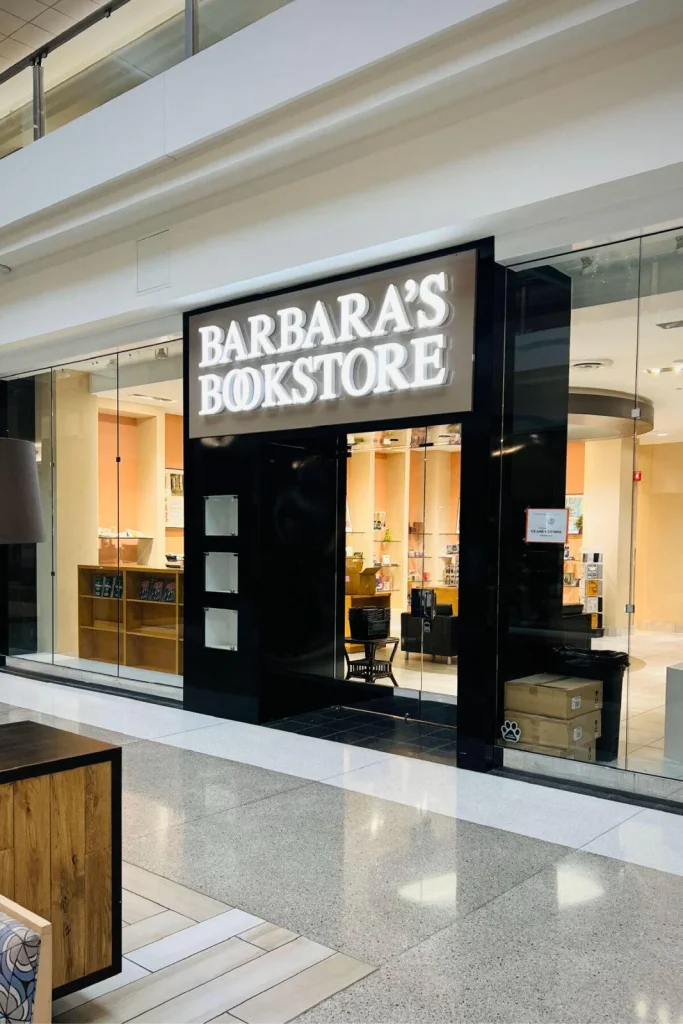
SignFreaks has built both styles for storefronts across Chicago and the suburbs, including front lit letters for Barbara’s Bookstore, shown in the portfolio. For the basics of how the letters are built, see what channel letters are, or compare them with other types of business signs.
See both lighting styles on your building
Send SignFreaks a photo of your storefront. We’ll mock up front lit and halo lit channel letters to scale, then design, permit, build, and install the one you pick.
Halo Lit Channel Letters FAQs
What is the difference between halo lit and front lit channel letters?
The difference between halo lit and front lit channel letters is where the light goes. Front lit letters shine through a translucent face toward the street, while halo lit letters have solid metal faces and shine backward onto the wall. See our channel letters page for both styles.
Are reverse channel letters the same as halo lit letters?
Reverse channel letters are the same as halo lit letters. Both names describe metal-faced letters mounted off the wall on standoffs, with LEDs pointed backward to create a glow around each letter.
Which is more visible at night?
Front lit channel letters are more visible at night from a distance, because the whole face glows. Halo lit letters read clearly at close and mid range, which suits pedestrian streets, lobbies, and corporate buildings.
Do halo lit channel letters cost more?
Halo lit channel letters usually cost more than front lit letters of the same size, because they need finished metal faces, standoffs, and more fabrication time. Your exact price depends on size, materials, mounting, and permits, so SignFreaks quotes after a site survey.
Can halo lit letters go on a brick wall?
Halo lit letters can go on a brick wall, but dark or rough brick dulls the halo. Mounting the letters on a smooth aluminum or acrylic backer panel gives the light a clean surface to reflect from.