
A winter vestibule is a second set of doors around your entrance, so cold air never rushes straight into the room. A temporary one goes up for the cold months and comes down in spring. A permanent one stays all year and can carry your branding. On a Chicago sidewalk, a temporary vestibule is capped at 6 months a year, so the temporary vs permanent vestibule choice affects your permit too.
Every Chicago business with a busy door knows the moment. The door opens, a wall of cold crosses the front of the room, and the tables nearest the entrance sit empty until April. Customers don’t complain about it. They sit somewhere else, or they leave.
A winter vestibule fixes that, but it raises a decision that trips up a lot of owners: the temporary vs permanent vestibule choice. This guide explains how each one works, what Chicago’s code says about vestibules on the sidewalk, and how a vestibule fits with the awning and the channel letters on the same storefront. It’s for restaurant owners, retailers, and property managers.
- A vestibule works as an air lock. Two sets of doors keep the cold from crossing the room every time someone walks in.
- The temporary vs permanent vestibule choice depends on the door. Temporary suits a cold-season fix, and permanent suits a branded, year-round entrance.
- The sidewalk has limits. Chicago caps a temporary vestibule at 6 months a year, 3 feet out, and one-fourth of the sidewalk width.
- The whole frontage should work together. The awning, the lit sign, and the vestibule should be planned as one entrance.
What a Winter Vestibule Does for a Chicago Entrance
A vestibule creates an air lock. The outer door closes before the inner door opens, so wind and cold never reach the dining room or the sales floor in one gust. A single door can’t do that, however well it seals. We built two of them for the Secretary of State’s flagship DMV downtown, and those vestibule enclosures now shelter one of the busiest doors in the Loop.
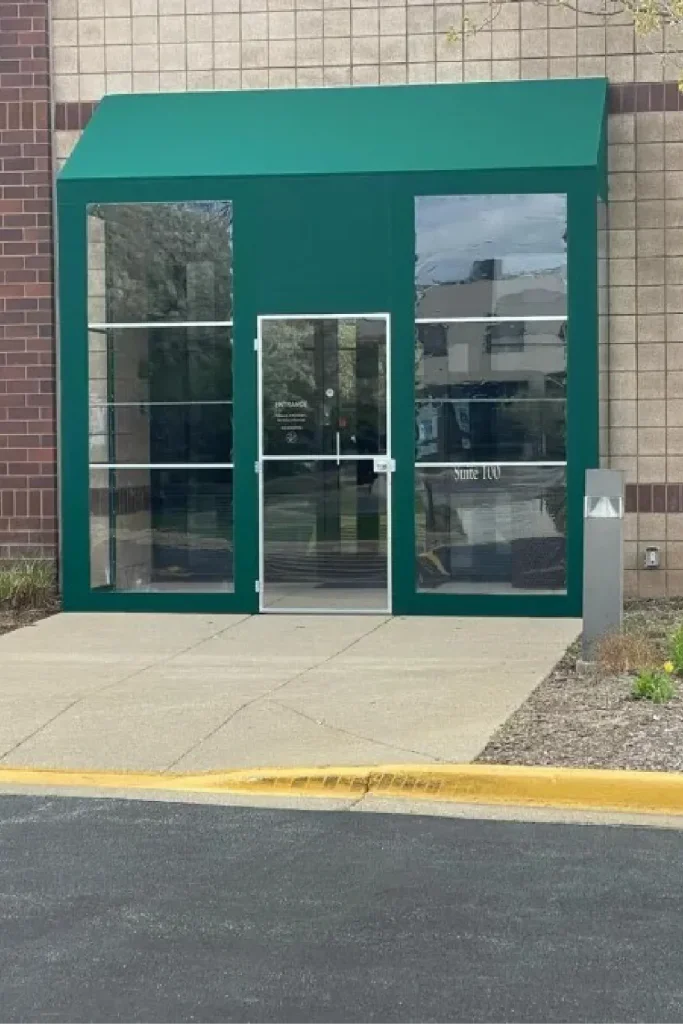
The payoff is practical. Staff stop working in a draft, the seats by the door fill again, and heated air stays inside longer. Energy codes require vestibules at many commercial entrances in cold climates for the same reason.
Businesses that get the most from one share a pattern: a door that opens constantly, a front room where customers sit or wait, and a lease that doesn’t allow a rebuilt storefront. Restaurants and cafes, salons, clinics, hotel lobbies, and retail strips all fit it. Our commercial vestibules are built for exactly those entrances.
Temporary vs Permanent Vestibule: How to Choose
Both versions use the same basic parts: a frame, clear panels, a second set of doors, and a roof. The difference is how long the structure stays and what it means for your building and the city.
| Feature | Temporary | Permanent |
|---|---|---|
| How long it stays | The cold months, then comes down | Year-round |
| Spring and summer | Entrance returns to normal | Stays up as part of the storefront |
| Storage | Removed and stored between seasons | None needed |
| Sidewalk limits | 6 months a year, 3 ft, one-fourth of the sidewalk | Reviewed as a permanent structure |
| Branding | Light, often clear panels | Full graphics, lighting, and signage |
| Best for | Seasonal relief on a leased storefront | Busy doors that need shelter all year |
A temporary vestibule makes sense when the problem is seasonal and the lease or the sidewalk rules out a permanent structure. SignFreaks offers seasonal removal, storage, and reinstallation, so the same vestibule can return each fall. A permanent vestibule makes sense when the door is busy all year or should carry your name.
Either way, the cost of a winter vestibule comes from the doorway, so size, doors, and anchoring set the number.
Know the sidewalk rules before you order. Chicago’s code says a temporary vestibule “shall not be erected for a period of time exceeding 6 months in any 1 year,” can’t extend more than 3 feet or one-fourth of the sidewalk width past the property line, and “shall not contain seating.” It also needs city approval. We file the sign permits before anything is built.
Vestibule, Awning, or Canopy: Which Fixes Your Entrance?
Many owners call about a vestibule when the real complaint is snow landing on customers at the door. Others install an awning and wonder why the room is still cold. The two solve different problems, so match the fix to the complaint.
| Your problem | Best fit | Why |
|---|---|---|
| Cold air crosses the room | Vestibule | The second set of doors blocks the draft |
| Snow and rain land on people at the door | Awning | A fixed awning covers the doorway and carries the name on the valance |
| A long walk from the curb or lot | Walkway canopy | Steel or aluminum cover over the full path |
| Heavy foot traffic and a draft | Entrance canopy plus vestibule | One keeps weather off the approach, the other stops the draft inside |
An awning won’t stop a draft, and a vestibule won’t shelter a line of people waiting outside. Together they cover both. If snow is your main worry, a fixed snow awning has the pitch and frame to carry winter weight, and the right awning fabric keeps the cover tight through the cold.
Not sure if you need a vestibule or an awning?
Send SignFreaks a photo of your entrance and tell us what bothers you most. We’ll recommend the fix, show it on your own storefront, and give you a written quote.
Keep Your Sign Visible When the Days Get Short
Winter changes when customers see your storefront. In December the sun sets in Chicago before 4:30 p.m., so most of the afternoon rush happens after dark. Your lit sign becomes the storefront for much of the day, and a new vestibule can either help it or hide it.
Three habits keep the entrance readable:
- Keep the sightline clear. Panels in front of a sign should be clear, and the vestibule roof shouldn’t cut across the lettering. Plan the position of the vestibule and the sign together.
- Light the entrance. Vestibule lighting and front lit or halo lit channel letters work as a pair, one marking the door and the other the business.
- Test the sign before the holidays. A dead module is easy to miss in October and costly in December. If a letter is out, sign repair usually means swapping a single LED module or power supply.
If you’re adding new lettering to the entrance, channel letters are the usual choice for retail and restaurants, and what they cost depends on size, lighting, and mounting.
Inside or Outside the Building Line?
A vestibule can sit inside the premises or on the frontage, and each trades something.
- Inside. Approval is usually simpler and the frontage stays unchanged, but the vestibule takes floor area you may be using for seats or displays.
- Outside. You keep every square foot inside, but the structure is visible from the street and may need public way approval, so it has to look intentional.
Whichever you choose, the door layout is what makes it work. The floor space has to be large enough that the outer door can close before the inner door opens, and exit hardware has to let people out without a key. We check both before the drawing is final.
How to Get a Vestibule in Before the Cold Sets In
Vestibule demand peaks between November and February, and the build includes design, permit review, and fabrication. So the start date counts for more than any detail of the design. A vestibule project follows six steps:
- Site assessment SignFreaks measures the entrance, checks the wall and the sidewalk, and notes how many people use the door.
- Custom design The drawing sets the frame, panels, roof, and door positions for your location and brand.
- Permits We prepare the drawings and file what the location requires, so nothing is built before approval.
- Fabrication The frame is built in our own Chicago shop from galvanized steel or aluminum, with panels cut to fit.
- Installation Our crew anchors the vestibule with reinforced hardware and checks every door during sign installation.
- Seasonal service For a temporary vestibule, we handle removal, storage, and reinstallation each year.
Choosing a Winter Vestibule for Your Business
The right winter vestibule fits how your door is used and what your building allows. That settles the temporary vs permanent vestibule question. Go temporary when the problem is seasonal and the sidewalk or lease limits what you can build. Go permanent when the door is busy all year and the entrance should carry your brand. Either way, plan the awning and the sign with it.
SignFreaks designs, permits, builds, and installs vestibules, commercial enclosures, awnings, and channel letters for businesses across Chicago and the suburbs. Patios that need shelter get windscreens built in the same shop.
Get your winter vestibule before the first snow
Send a photo of your entrance and your deadline. SignFreaks will measure, design, permit, build, and install a vestibule built for Chicago winters.
Winter Vestibule FAQs
What is the difference between a temporary and a permanent vestibule?
The difference between a temporary and a permanent vestibule is how long it stays up. A temporary vestibule goes up for the cold months and comes down in spring, while a permanent one stays year-round and can carry full branding and lighting. We build both as commercial vestibules.
How long can a temporary vestibule stay up in Chicago?
A temporary vestibule can stay up for no more than 6 months in any year under the Chicago Building Code. It also can’t extend more than 3 feet or one-fourth of the sidewalk width past the property line, and it can’t contain seating. We file the sign permits for the project.
Does a vestibule need a permit in Chicago?
A vestibule in Chicago needs drawings and review before it is built, because it’s a structure attached to or beside the building. One that extends over the public way also needs city approval. We prepare the drawings and handle the permits as part of every project.
Should I get a vestibule or an awning?
You should get a vestibule if cold air crosses the room, and an awning if snow and rain fall on people at the door. A vestibule blocks the draft, while a fixed awning shelters the approach and carries your name. Many storefronts use both.
Can a vestibule carry my branding?
A vestibule can carry your branding through custom graphics, lighting, and branded panels, so the entrance reads as part of the storefront. We can match it with channel letters or an awning so the whole frontage comes from one shop.